• HYBRID TRACK • VISIBILITY ENGINEERING

Some businesses need to win locally and nationally.

Hybrid Search Systems Engineering helps businesses with local presence and broader market authority show up clearly across Google, Maps, AI results, comparison searches, citations, and category-level recommendations — and so you can measure both your local actions and your category visibility every month.

Built for franchises, regional service firms, professional services, multi-location brands, and companies with both local markets and broader category demand.

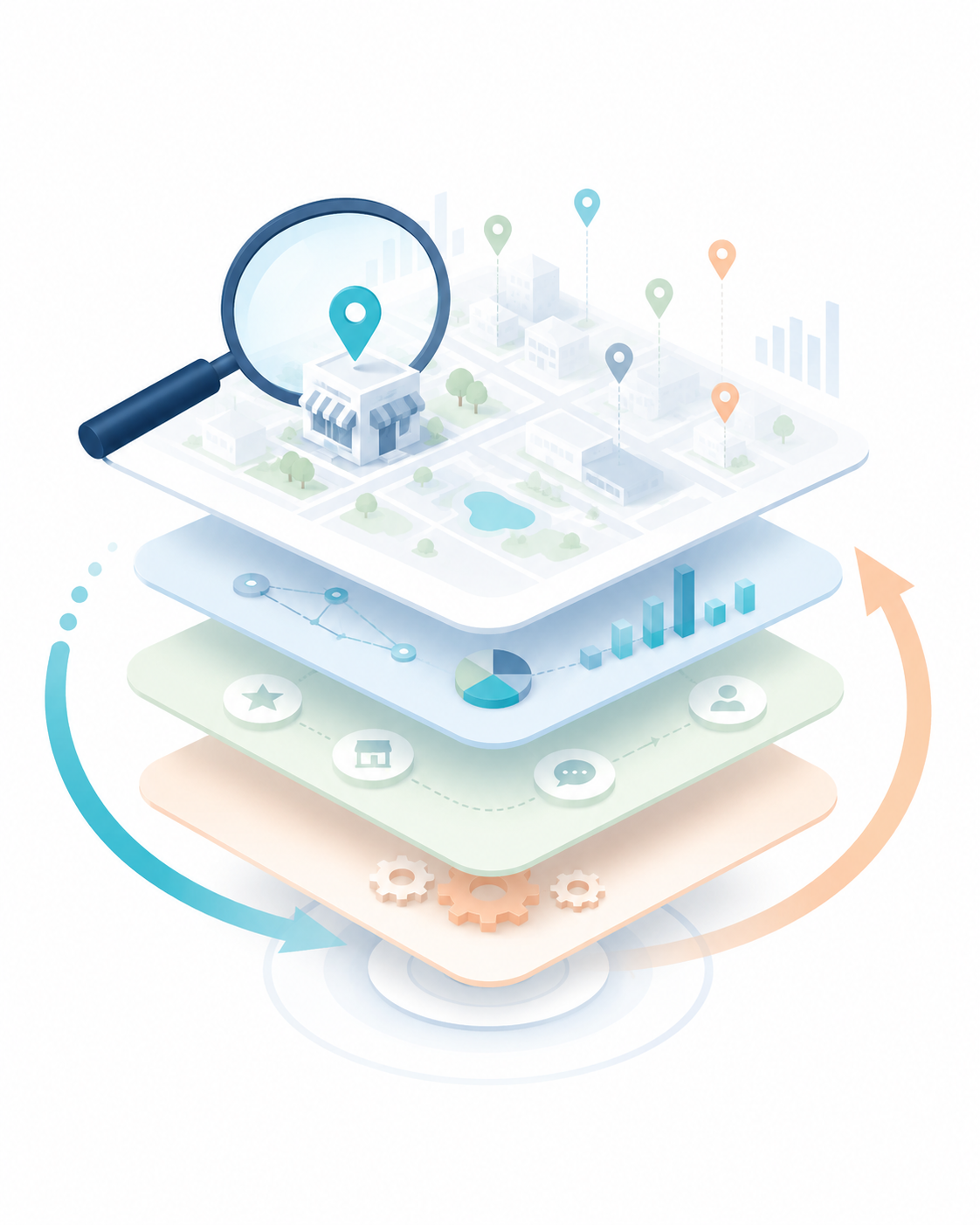
Isometric illustration of connected local map pins and floating data layers representing hybrid local and national search visibility.

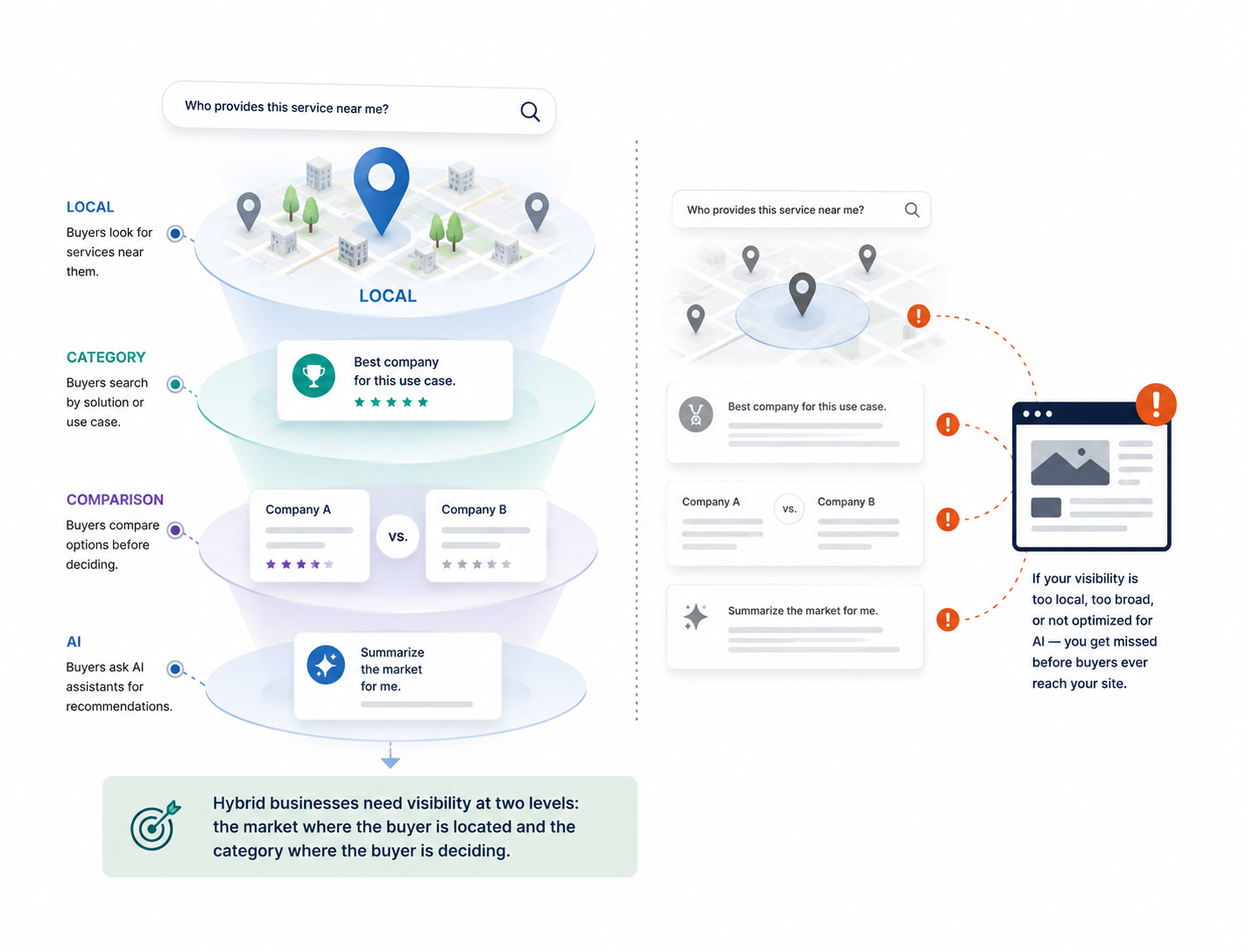
Your buyers do not always search at one level.

  • Local “Who provides this service near me?”
  • Category “Best company for this use case.”
  • Comparison “Company A vs. Company B.”
  • AI “Summarize the market for me.”

That creates a hybrid visibility problem.

If your strategy is too local, you may appear in Maps but fail to build broader authority. If your strategy is too national, you may create category content but miss location-level leads. If your AI visibility is weak, competitors may be recommended before buyers ever reach your website.

Illustration of local map pins and category documents separated by a visibility gap with warning indicators.

Hybrid visibility fails when local and national signals are disconnected.

Local pages exist, but category authority is weak

You may rank in local markets, but your category and comparison pages aren’t strong enough for AI systems and buyers to see you as a category leader — so competitors win the ‘best [category]’ and comparison queries.
Category pages exist, but local intent is underdeveloped

The website explains the service nationally, but individual markets, branches, or service areas lack local context to convert nearby buyers.

Google Business Profiles are inconsistent

Locations may have different categories, incomplete services, uneven review signals, weak photos, or inconsistent descriptions.

Competitors own comparison & recommendation searches

AI assistants and search results may surface competitors because they have stronger category pages, third-party mentions, or comparison content.

Brand facts vary by location

AI and search systems struggle when services, locations, industries, or capabilities are described inconsistently across markets.

Reporting separates local SEO from broader demand

Local visibility, organic content, AI mentions, calls, and competitor recommendations are often measured separately instead of as one journey.

Hybrid businesses need both market presence and category authority.

A local-only approach may improve Maps visibility but fail to build proof for AI recommendations and category trust. A national-only approach may build authority but fail to convert nearby buyers. Hybrid Search Systems Engineering connects both sides.

Local-only
National-only
Hybrid Search Systems Engineering
Focuses on locations
Focuses on category pages
Connects local markets and category authority
Optimizes GBP and Maps
Optimizes broad organic content
Aligns GBP, location pages, service pages, and AI visibility
Tracks local rankings
Tracks organic traffic
Tracks local actions, category visibility, AI mentions, and leads
May miss comparison searches
May miss nearby-intent searches
Supports both local and decision-stage discovery
Market-by-market execution
Centralized content execution
Unified system with local adaptation
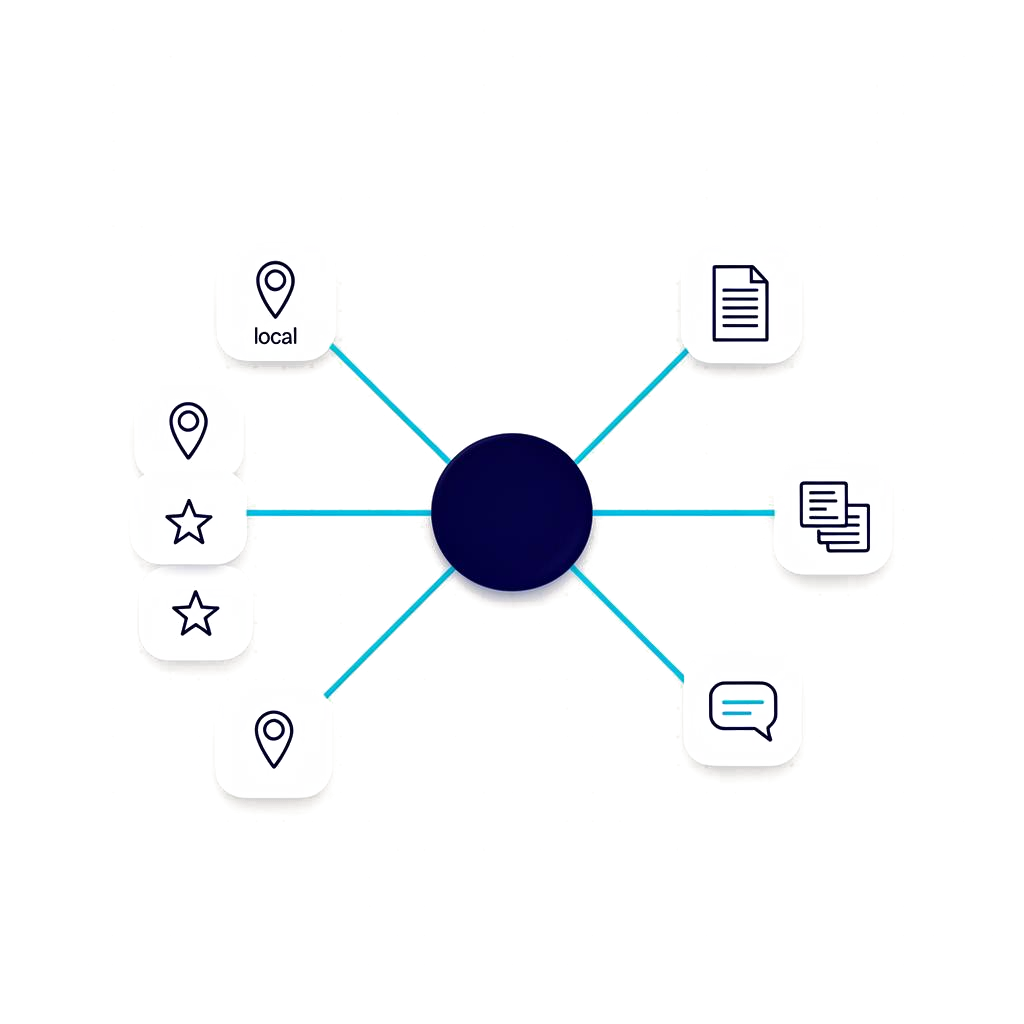
Hub diagram connecting local map pins and category content signals to one central hybrid visibility system.

Hybrid Search Systems Engineering connects local demand with category authority.

The process of improving visibility for businesses that need both location-level discovery and broader category-level authority across Google, Maps, AI results, answer engines, citations, reviews, and owned conversion paths.

It combines local SEO, category/national SEO, continuous AI visibility measurement, structured content, citation work, source-of-truth pages, and entity accuracy into one measurable system.

The goal

Make it easier for buyers and AI systems to understand:

  • What your business does
  • Which markets you serve
  • Which locations support those markets
  • Which industries or use cases you specialize in
  • Why your brand should be trusted
  • How a buyer should take the next step

The work connects location-level execution with broader authority building.

Location & Market Page Engineering

Service depth, local proof, FAQs, market context, schema, internal links, and calls to action on every location page.

Google Business Profile Alignment

Categories, services, photos, descriptions, Q&A, reviews, and conversion paths support the same brand story across locations.

Category & Service Authority Content

Build or improve service pages, category pages, use-case pages, comparison content, and educational assets.

AI Visibility & Prompt Testing

How the business appears for local, regional, category, and comparison AI prompts — scored as your AI Visibility Score and Share of Model.

Source-of-Truth Architecture

Clarify core facts, services, locations, industries, credentials, and differentiators as one reliable reference.

Citation & Third-Party Signals

Review local citations, industry directories, review platforms, and external sources that influence search and AI.

Review & Reputation Strategy

Evaluate reviews across locations and platforms, identify trust gaps, and improve how reputation supports decisions.

Action-Based Reporting

Local actions, organic visibility, AI mentions, competitor presence, calls, forms, and qualified inquiries together.

Measure first. Then engineer both local demand and category authority.

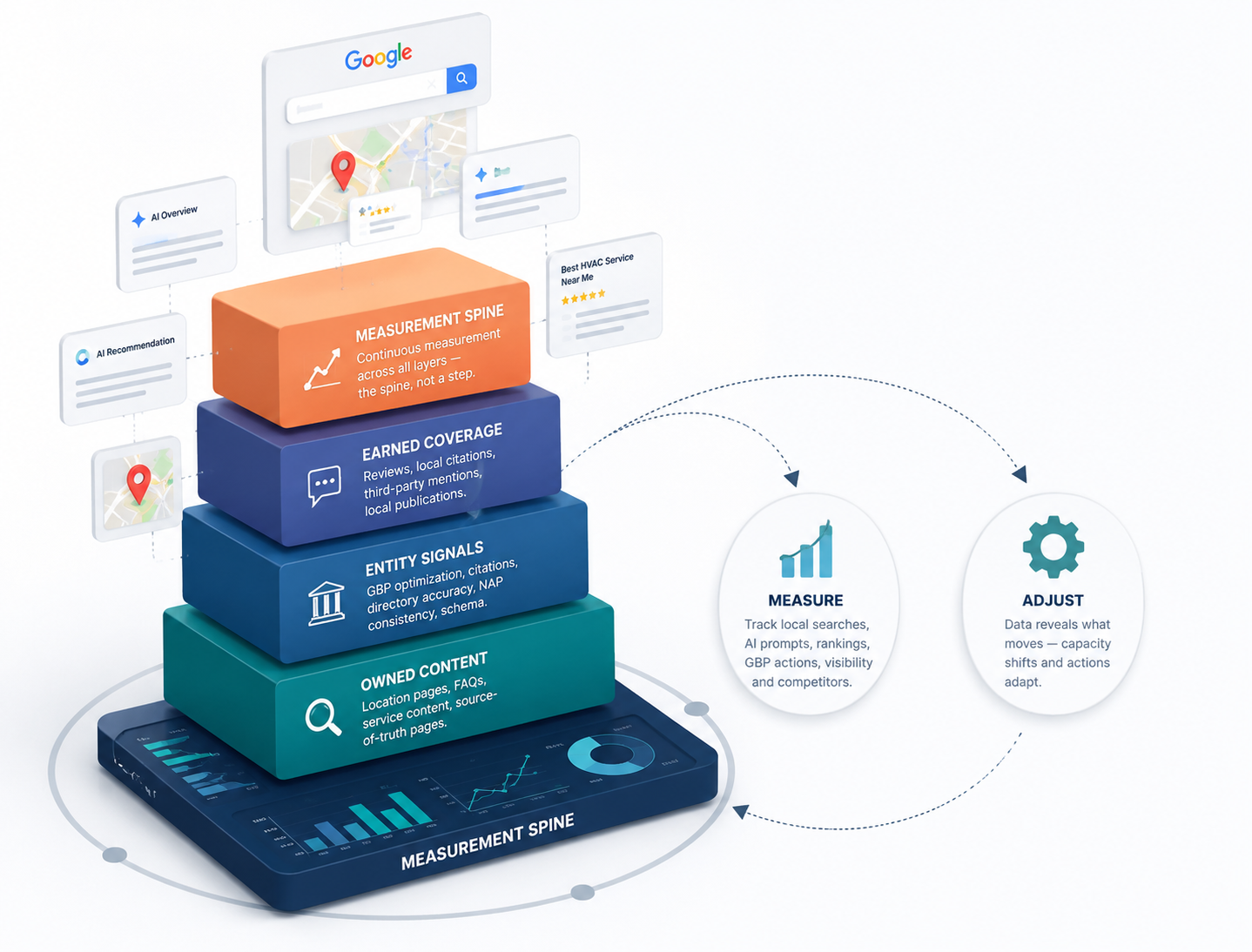
Four-layer engagement diagram with measure, engineer, and adjust cycle.

Measure

We map local searches, category searches, comparison queries, and AI prompts; baseline where you appear at both the market level and the category level; then re-test every cycle — tracking GBP actions, Share of Model, AI recommendations, source accuracy, and competitors.

Engineer the four layers

  • Owned content: Location/market pages, category and comparison pages, FAQs, source-of-truth pages.
  • Entity signals: GBP alignment across locations, citation accuracy, NAP consistency, schema.
  • Earned coverage: Reviews across locations, local and industry citations, third-party mentions, category publications.
  • Measurement spine: Continuous measurement runs across all three layers — it is the spine, not a step.

Adjust

The data decides the next move — capacity shifts toward whatever is moving local actions and category visibility.

In the first 30 days, you get a hybrid visibility baseline.

Before building new content or making recommendations, we identify where visibility stands across both local and broader search surfaces.

Get your free AI Entity Accuracy Audit
  1. Local and category visibility review
  2. Google Business Profile review by location
  3. Location page and service page review
  4. Competitor visibility snapshot
  5. AI recommendation testing
  6. Citation and third-party source review
  7. AI Entity Accuracy findings (by severity)
  8. Priority action plan

Hybrid visibility should connect market activity to business outcomes.

GBP Actions (primary)

Calls, direction requests, messages, bookings, and form submissions — the location-level primary metric.

Share of Model (primary)

AI Visibility Score and Share of Model across local, regional, and category prompts — the brand-level primary metric.

Category Visibility

Category and comparison page performance — the surface Share of Model measures.

Citation Source Mix

Which directories and sources AI cites for your local and category queries.

Hallucination Rate & KG Confidence

Entity accuracy across the seven-category severity battery and Google Knowledge Graph confidence.

Location Visibility (supporting)

Maps Pack visibility and local organic — supporting context as click-through structurally declines.

Reputation Signals

Review quality, themes, response quality, and location-level trust.

Lead Quality

Qualified inquiries, demo requests, consultation requests, and other business actions.

Best for businesses that compete in markets and categories.

Franchise & Multi-Location Brands

Brands that need location-level discovery while maintaining consistent national or regional authority.

Regional Service Firms

Companies serving multiple cities, counties, states, or service areas with overlapping local and category demand.

Professional Services Firms

Firms that need market-level visibility and broader authority around practice areas, industries, or specializations.

B2B Companies with Local Offices

Companies that sell nationally or regionally but still need office-level trust, local proof, and market-specific landing pages.

SaaS / Tech with Regional Presence

Companies with product authority needs plus local sales offices, implementation partners, or regional markets.

The same hybrid system, scaled to your footprint.

A two-location professional firm, a regional service company, and a franchise network do not need the same operating depth. The Hybrid track scales based on locations, market complexity, category competition, content gaps, review profile, citation accuracy, and AI visibility needs.

Tier is set by how much we measure — prompt universe size, locations, platforms, and cadence — not a deliverable count.

See Hybrid pricing options

This is not local SEO plus a few blog posts.

Not this

  • Separate local and national campaigns with no shared strategy
  • Thin city pages without category depth
  • Broad content with no local conversion path
  • GBP work disconnected from website content
  • Ranking reports without lead or AI context
  • Guaranteed AI recommendations
  • Guaranteed rankings in every market

This instead

  • A connected visibility system
  • Market-level and category-level strategy
  • Structured content for humans and AI systems
  • Better source accuracy across locations
  • Measurement across search, AI, and business actions
  • A scalable model for growing across markets

Hybrid Search Systems Engineering FAQs

What is Hybrid Search Systems Engineering?

Hybrid Search Systems Engineering improves visibility for businesses that need both local-market discovery and broader category-level authority across Google, Maps, AI results, citations, reviews, and owned conversion paths.

How is this different from local SEO?

Most of it is local SEO done well — Google Business Profile, reviews, citations, and location pages. What’s different is the measurement layer and entity accuracy: we test how AI assistants describe and recommend you across both local and category prompts, and we report GBP actions and Share of Model.

How is this different from national SEO?

Most of it is national SEO done well — category pages, comparison content, and authority. What’s different is the local layer and the measurement layer: we connect market-level discovery to category authority, and we track AI visibility and entity accuracy alongside organic.

Who is the Hybrid track best for?

It is best for franchises, multi-location brands, regional service firms, professional services firms, B2B companies with offices, and SaaS or technology companies with regional presence.

Does this include Google Business Profile work?

Yes. For location-based businesses, GBP alignment is part of the Hybrid track because local profiles help support market-level visibility and conversion.

Does this include AI visibility testing?

Yes. We test local, regional, category, comparison, and recommendation-style prompts to understand how AI systems describe and position the business.

Can you guarantee rankings or AI recommendations?

No. Rankings and AI recommendations cannot be guaranteed. The goal is to improve the signals that make the business easier to find, understand, cite, trust, and choose.

What’s included in the AI Visibility & Entity Accuracy Audit?

The audit includes local and category visibility review, GBP review by location, page analysis, competitor visibility snapshot, AI recommendation testing, citation and third-party source review, AI Entity Accuracy findings across the seven-category severity battery, and a priority action plan.

Hybrid visibility

Buyers may search locally, compare nationally, and ask AI who to trust.

Your visibility system should support all three journeys. See where your local presence is strong, where category authority is weak, where competitors are winning, and what should be fixed first.