Google Business Profile is incomplete
The profile may exist, but categories, services, photos, Q&A, posts, descriptions, and conversion paths are not fully supporting buyer action.
Local Search Systems Engineering helps your business show up clearly across Google Maps, local search, reviews, citations, and AI-powered answers — so local buyers can find you, trust you, and contact you, and so you can measure where you actually appear every month.
Built for local service businesses, clinics, law firms, contractors, retail locations, restaurants, franchises, and multi-location operators.
A local buyer may search on Google, scan Maps, compare reviews, ask ChatGPT for options, read an AI-generated answer, and choose who to contact before clicking through to a full website.
That creates a visibility problem most local SEO programs are not built to solve.
You may have a website. You may have a Google Business Profile. You may even rank for some local keywords. But if your reviews are weak, your location pages are thin, your citations are inconsistent, your services are unclear, or AI systems describe competitors better than they describe you, buyers may never choose you.
The profile may exist, but categories, services, photos, Q&A, posts, descriptions, and conversion paths are not fully supporting buyer action.
Review count, recency, response quality, and review themes all affect trust. A good rating alone is not always enough.
Many location pages say where the business is located, but not enough about services, proof, FAQs, service areas, or why that location should be trusted.
Directories and third-party listings may show outdated names, addresses, phone numbers, categories, hours, or services.
When buyers ask AI for local recommendations, the answer depends on what the model can understand from your website, profiles, reviews, and third-party sources.
Rankings matter, but local visibility should also be measured by calls, direction requests, forms, bookings, and qualified inquiries.
Basic local SEO usually focuses on Google Business Profile, citations, reviews, and rankings. Those still matter — but buyers now compare local businesses across more surfaces, and AI systems summarize those signals into recommendations.

The process of improving how a location-based business appears across Google Maps, local organic search, Google Business Profile, AI-generated answers, reviews, citations, and location-specific website pages.
The process of improving how a location-based business appears across Google Maps, local organic search, Google Business Profile, AI-generated answers, reviews, citations, and location-specific website pages.
Make it easier for local buyers and AI systems to understand:
Categories, services, descriptions, photos, Q&A, posts, profile completeness, and conversion paths.
Relevance, proximity, prominence, reviews, citations, competitor strength, and local content alignment.
Service details, service areas, FAQs, proof points, reviews, local context, schema, and calls to action.
Review request workflows, response quality, review themes, and reputation signals that support buyer trust.
Audit and improve local listings so business details are consistent across important platforms and directories.
How your business appears when buyers ask AI for local recommendations — scored as your AI Visibility Score and tracked over time.
LocalBusiness, Service, FAQPage, Organization, and location-specific schema where appropriate.
Calls, forms, direction requests, bookings, GBP actions, AI mentions, and qualified inquiries.
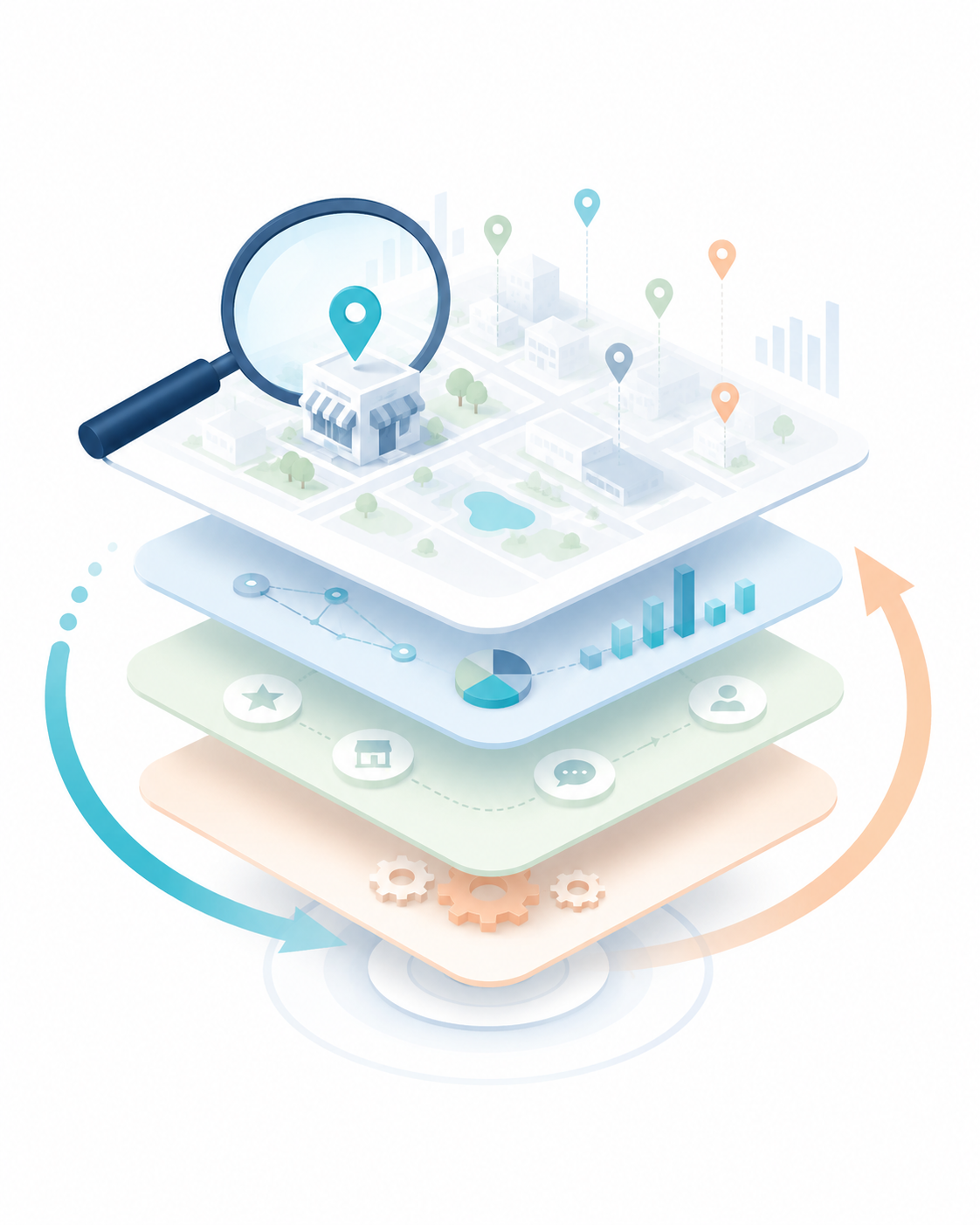
We map the local searches and AI prompts buyers actually use, baseline where you appear across Google, Maps, and AI assistants, then re-test every cycle — tracking GBP actions, AI recommendations, source accuracy, and competitors.
The data decides the next move — capacity shifts toward whatever is moving GBP actions and local AI visibility.
Before making recommendations, we show where your local presence stands today.
Get your free AI Entity Accuracy AuditCalls, website clicks, direction requests, messages, and bookings — the primary local metric.
How often AI assistants mention, recommend, and accurately describe you for local buyer prompts.
Which directories and sources AI cites for local queries — not just whether listings are consistent.
Entity accuracy across the seven-category severity battery and Google Knowledge Graph confidence.
Review volume, rating, recency, response rate, and themes buyers mention.
Maps Pack and local organic visibility — supporting context, not the headline outcome.
Traffic, engagement, and service-level visibility — context as click-through structurally declines.
Form submissions, calls, appointments, quote requests, and real business opportunities.
Contractors, repair services, home services, wellness providers, consultants, and professional service firms.
Medical, dental, therapy, wellness, and specialty clinics.
Firms competing for practice-area and city-level searches.
Businesses where Maps, reviews, hours, photos, directions, and nearby intent influence visits.
Brands with multiple branches, offices, clinics, stores, or service areas.
Businesses that need location-level visibility with brand consistency across markets.
A single-location business, a competitive metro-area provider, and a multi-location brand do not need the same operating depth. The Local track can be delivered at different levels based on locations, market competition, review profile, content gaps, citation accuracy, and AI visibility needs.
Tier is set by how much we measure — prompt universe size, testing cadence, platforms, and locations — not by a deliverable count.
See Local pricing optionsScan the left for busywork that looks productive. The right is what actually moves local buyers — and what we run every month.
Local Search Systems Engineering improves how a location-based business appears across Google Maps, local organic search, Google Business Profile, AI-generated answers, reviews, citations, and location-specific website pages.
Most of it is local SEO done well — Google Business Profile, reviews, citations, and location pages. What’s different is the measurement layer: we test how AI assistants recommend and describe you locally, and we report GBP actions, not just rankings.
Yes. Google Business Profile remains one of the most important local visibility and conversion surfaces. Buyers can call, request directions, read reviews, view photos, and compare competitors directly from the profile.
No. Local rankings depend on relevance, proximity, prominence, competition, reviews, content, and user behavior. The goal is to improve the signals that increase local visibility and buyer action over time.
AI assistants can summarize local options, recommend businesses, explain reviews, compare providers, and answer buyer questions before the user visits a website.
The audit includes Google Business Profile review, Maps visibility snapshot, location page review, review signal analysis, citation accuracy check, competitor visibility snapshot, AI local recommendation testing, an entity accuracy review across the seven-category severity battery, and a priority action plan.