How it works

Search visibility is no longer a checklist. It’s a system.

Search Systems Engineering is a measurement-led operating model for how your business appears across Google, Google Maps, and AI assistants like ChatGPT and Gemini.

We measure where you actually show up every month, then do the SEO, local, content, and digital PR work that moves it. The measurement layer is what makes it a system instead of a checklist.

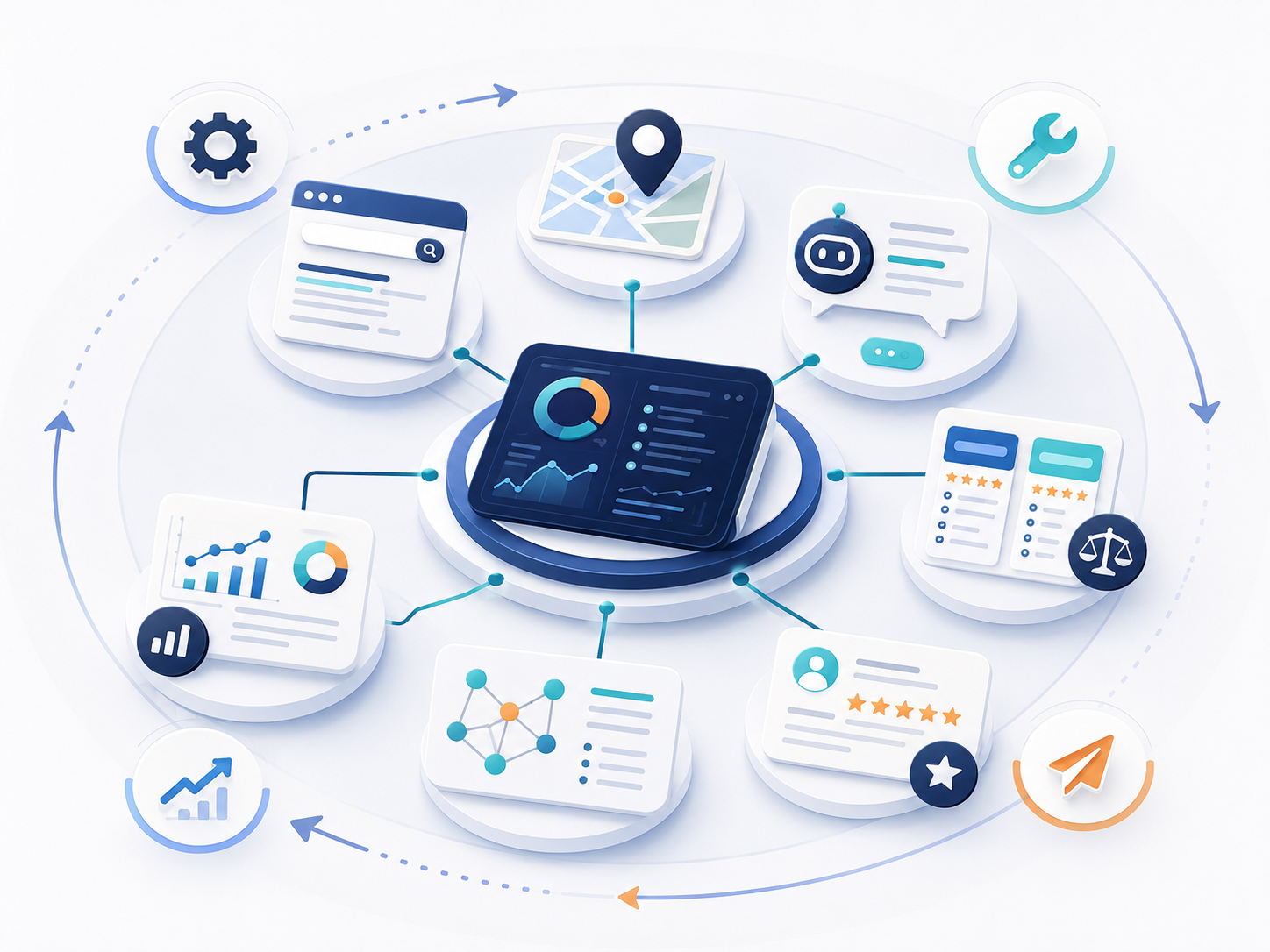
Isometric hub connecting measurement dashboards, content surfaces, local maps, and AI assistant signals in one visibility system.

The old search model was built around rankings. The new one is built around decisions.

For years, search strategy focused on a familiar path: rank in Google, earn the click, bring the visitor to the website, and convert the lead.

That path still matters. But it is no longer the only path.

Buyers now search across Google, Maps, AI search, ChatGPT-style assistants, review platforms, comparison pages, third-party sources, and community discussions. Many of those moments happen before a buyer reaches your site. Some happen without a click at all.

That creates a different visibility problem. You do not only need to rank. You need to be found, cited, accurately represented, and chosen across the surfaces where buyers form trust.

The question is no longer only, “Where do we rank?” It is, “Where are we visible when buyers decide?”

Search Systems Engineering turns discovery into an operating system.

Search Systems Engineering is the practice of designing, measuring, and improving a business’s visibility across traditional search engines, local discovery surfaces, AI assistants, and AI search.

  • SEO foundations

  • Local search optimization

  • Google Business Profile signals

  • AI search visibility

  • Prompt universe research

  • Citation engineering

  • Structured content and schema

  • Source-of-truth pages

  • Third-party authority signals

  • AI Entity Accuracy Audit

The goal is not more marketing activity. The goal is a visibility system that can be measured, improved, and defended over time.

Measure first. Then engineer the four layers.

Every engagement runs the same loop. We measure where you stand, engineer the four layers that drive visibility, then re-measure and adjust. The work changes by business type; the model stays consistent.

01

Measure

Map how buyers search, baseline where you appear, and re-test every cycle.

Measurement is the product. We build the prompt universe, baseline visibility across Google, Maps, and AI assistants, run the AI Entity Accuracy Audit, then re-test on a monthly or bi-weekly cycle so we can prove what moved instead of guessing.

What this layer includes
  • Google and local search queries
  • ChatGPT, Gemini, Perplexity, Copilot prompts
  • Customer questions from sales and support
  • Hallucinations and inaccuracies (by severity)
  • GBP actions, calls, direction requests
  • Google Business Profile discovery terms
  • Comparison and competitor prompts
  • AI answers and which sources they cite
  • Competitor recommendation patterns
02

Owned content

Content that ranks and that AI can extract and cite cleanly.

Content now has two jobs: persuade human buyers and be clear enough for AI systems to extract, summarize, and cite accurately. We build the owned base that lives on your site.

What this layer includes
  • Source-of-truth pages
  • Service and solution pages
  • Comparison content
  • Case studies and proof assets
  • Content designed for AI extraction
  • Local landing pages
  • FAQ libraries
  • Use-case pages
  • Definition-style answer blocks
03

Earned coverage

Mentions across the sources AI learns from and cites.

AI systems are taught by the open web — reviews, articles, communities, and trusted publications. We do the digital PR and outreach work that gets your business named in the places models actually read.

What this layer includes
  • Review platform presence
  • Industry publication opportunities
  • Third-party mentions
  • Community and forum visibility where relevant
04

Entity signals

Consistent, accurate identity across every profile and index.

AI and search systems need to recognize you as one specific business — not confuse you with someone else. We keep your entity clean across every public surface that defines you.

What this layer includes
  • Google Business Profile
  • Business directory accuracy
  • Entity consistency across public sources
  • Local and industry citations
  • Partner and association listings

Two inputs. Four layers. One measured system.

AI answers are built from two inputs — what the model learned from the web, and what it retrieves live. Our four execution layers feed those two inputs, and the measurement layer tracks all of it.

01

Owned content

Your website pages, local pages, FAQs, and comparison content — structured so they rank in Google and Bing and get cited when AI retrieves live.

02

Earned coverage

Reviews, articles, community discussions, and trusted publications — the mentions that teach AI systems to recommend you over time.

03

Entity signals

Google Business Profile, directories, schema, and consistent business data — so you’re correctly identified as one distinct business.

04

Measurement

Continuous testing of where you appear, what AI says about you, who it cites, and what’s changing — the layer most programs skip.

Isometric phone with search layers representing live retrieval and learned web signals feeding visibility.
Visibility is only valuable when it creates trust, action, and a path back to your business.

Traditional SEO improves rankings. Search Systems Engineering improves visibility systems.

Traditional SEO is still important. It gives your business technical strength, discoverable pages, search authority, and organic visibility. But modern discovery requires more than rankings.

Traditional SEO

Search Systems Engineering

Focuses on rankings and traffic
Focuses on visibility, citations, accuracy, and leads
Optimizes web pages for Google
Optimizes across Google, local search, and AI assistants
Measures clicks and impressions
Measures business actions, AI mentions, source quality, and competitor presence
Creates keyword-targeted content
Creates structured, answer-ready, citation-worthy content
Treats reputation separately
Includes AI accuracy monitoring and source correction
Often works as a campaign
Operates as a recurring system

A system needs measurement.

The methodology is built around the metrics that connect to business outcomes — not vanity numbers. These are the same metrics that appear on your monthly report.

Sample tiles below — illustrative values, not a real client.

Sample measurement dashboard with trend line, source mix chart, and reporting rows.
+0.6 vs. baseline
3.8 / 5

AI Visibility

AI Visibility Score (1–5) and Share of Model — the percentage of answers that mention or recommend you.

+28% MOM
412 actions / mo

Local Visibility

GBP actions — calls, direction requests, and message taps — the primary local metric.

+2 new this cycle
7 / 12 top sources

Citation source mix

Which source types AI cites in your category, whether you appear in them, and how that mix is shifting.

−3.1 pts MOM
4.2% hallucination rate

Accuracy & Risk

Hallucination Rate from the AI Entity Accuracy Audit — scored by severity with fix paths.

+9% MOM
1.4M impressions / mo

Search Visibility

Rankings, indexed pages, and technical health as supporting context — not the headline metric.

Above target
612 / target 500

Entity strength

Knowledge Graph Confidence Score — how strongly Google and downstream AI recognize you as one business.

+34% MOM
186 qualified leads

Conversion Signals

Calls, form submissions, qualified visits — the business outcomes the visibility system creates.

Built for businesses that need to be found, trusted, and chosen.

Search Systems Engineering is most useful when buyers compare multiple options before making contact.

  1. Local Businesses

    Local track

    Companies that depend on Google Maps, local search, reviews, phone calls, and nearby-intent discovery.

  2. Multi-Location Businesses

    Local track

    Brands that need consistent visibility and accurate information across multiple cities, branches, offices, or service areas.

  3. Hybrid Businesses

    Hybrid track

    Companies that need both local presence and broader category authority.

  4. National Brands

    National track

    Businesses competing for category, comparison, and recommendation visibility across a wider market.

  5. SaaS Companies

    National track

    Software companies that need to appear in use-case searches, alternative searches, comparison queries, review platforms, and AI recommendations.

Start with a free AI Entity Accuracy Audit.

See where your business stands across Google and AI. Get a clear view of where you appear, where competitors are winning, what AI systems say about you, and what should be fixed first.

The audit is fast — a clear baseline in your first 30 days. Real movement compounds over time: local actions in the first 1–2 months, AI visibility over 6–12 months. We set that expectation up front.

Get your free AI Entity Accuracy Audit

How it works — FAQs

Short, direct answers about how the Search Systems Engineering methodology works.

What is Search Systems Engineering?

A measurement-led operating model for how your business appears across Google, Google Maps, and AI assistants. We measure where you actually show up, then do the SEO, local, content, and digital PR work that moves it.

Is this different from AEO?

Most of it is SEO and digital PR done well — that’s the honest answer. What’s different is the measurement layer: we systematically test where you appear across AI assistants, what they say about you, who they cite, and what they get wrong. AEO is just a label some agencies use for part of this; we don’t treat it as a separate discipline.

Why do citations matter for AI visibility?

AI systems rely on external sources to understand and summarize businesses. Strong, accurate citations reinforce what your business does, where it operates, and why it should be trusted.

What is a prompt universe?

A structured map of the questions, searches, comparisons, and AI-style prompts buyers use when researching a category or deciding which business to contact.

Why is reputation defense part of the methodology?

AI systems can generate incorrect or outdated information about your business. We monitor for accuracy and correct sources before bad answers affect buyer trust. For most businesses this is light-touch accuracy monitoring; coordinated reputation defense is a deeper focus for larger, multi-market clients.

How long does the methodology take to work?

You get a clear baseline in the first 30 days. After that, different signals move on different timelines: Google Business Profile actions in 30–60 days, AI visibility from live retrieval in 60–120 days, and AI visibility driven by training data from around month 9. We sell on a 12-month horizon for full maturity, and we tell you that before you start.

Talk to us

Your customers are already moving between Google, AI search, and ChatGPT-style assistants.

Search Systems Engineering gives you a way to measure, improve, and defend your visibility across that journey.

See where you appear, where competitors are winning, what AI systems say about you, and which visibility gaps should be fixed first.